
We are glad to share with you that our recent research paper “Advances in Video Anomaly Detection with Diffusion Discrimination and Thermal Feature Attention” has been published in IEEE Access (Impact Factor 4.2, JCR Q2, SJR Q1, CiteScore Q1):
Y. Pan, S. -H. Tsang and Y. -L. Chan, “Advances in Video Anomaly Detection with Diffusion Discrimination and Thermal Feature Attention,” in IEEE Access, doi: 10.1109/ACCESS.2026.3746503.
Paper Abstract
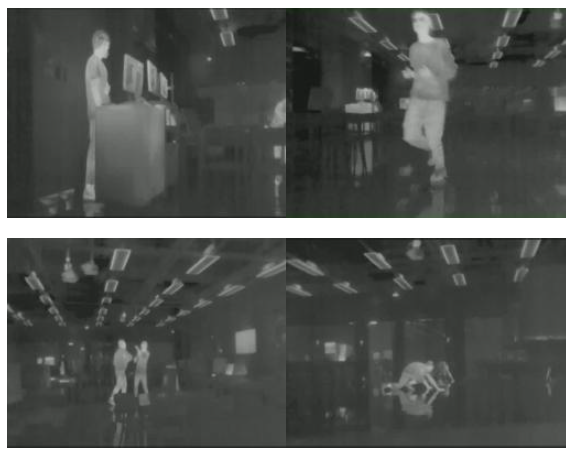
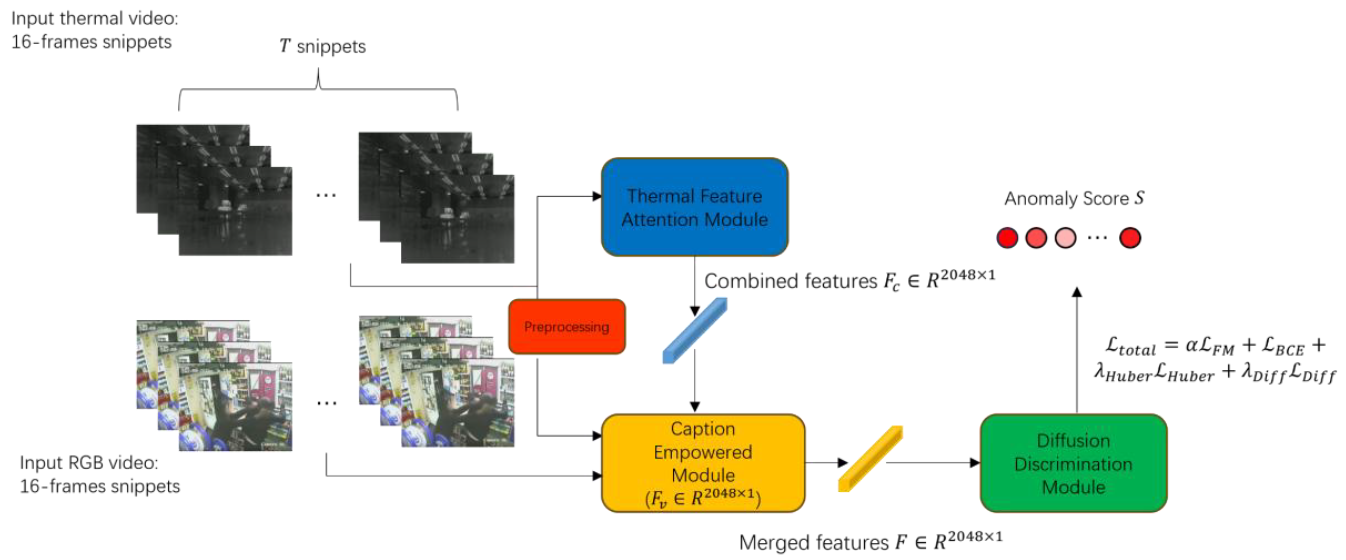
Video anomaly detection plays a crucial role in enhancing safety and security across diverse domains, including public surveillance, transportation, healthcare, retail, and industry. Despite substantial progress using spatiotemporal visual features from RGB videos, existing methods often struggle to generalize to complex real-world scenarios due to limited semantic understanding. Moreover, thermal video anomaly detection, which is essential for surveillance under low-light and challenging environmental conditions, is still relatively underdeveloped due to the scarcity of datasets and the inherent difficulties posed by grayscale, low-texture images. To address these gaps, this work proposes a novel integrated framework comprising three key modules: a thermal feature attention module specifically designed to enhance discriminative feature extraction from thermal videos; a caption empowered module that incorporates semantic features from dense video captions to complement visual cues; and a diffusion discrimination module for robust refinement of feature representations. Additionally, a new Indoor Anomaly Detection (IAD) thermal video dataset is constructed to facilitate research on indoor thermal surveillance scenarios. The adoption of the Huber loss function further improves model robustness in handling noisy labels, which are common in anomaly detection tasks. Experiments on RGB and thermal video datasets show improved detection performance and more precise temporal localization of anomalies compared with prior methods.
Hong Kong Chu Hai College is committed to collaborating universities to publish papers in international conferences and journals. More papers coming soon!
The research team members
Hong Kong Chu Hai College
- Dr Harris Sik-Ho Tsang, Assistant Professor, Department of Computer Science
The Hong Kong Polytechnic University
- Mr. Yikun Pan, PhD Student, Department of Electrical and Electronic Engineering
- Prof. Yui-Lam Chan, Associate Professor and Associate Head (Promotions and Global Relations), Department of Electrical and Electronic Engineering
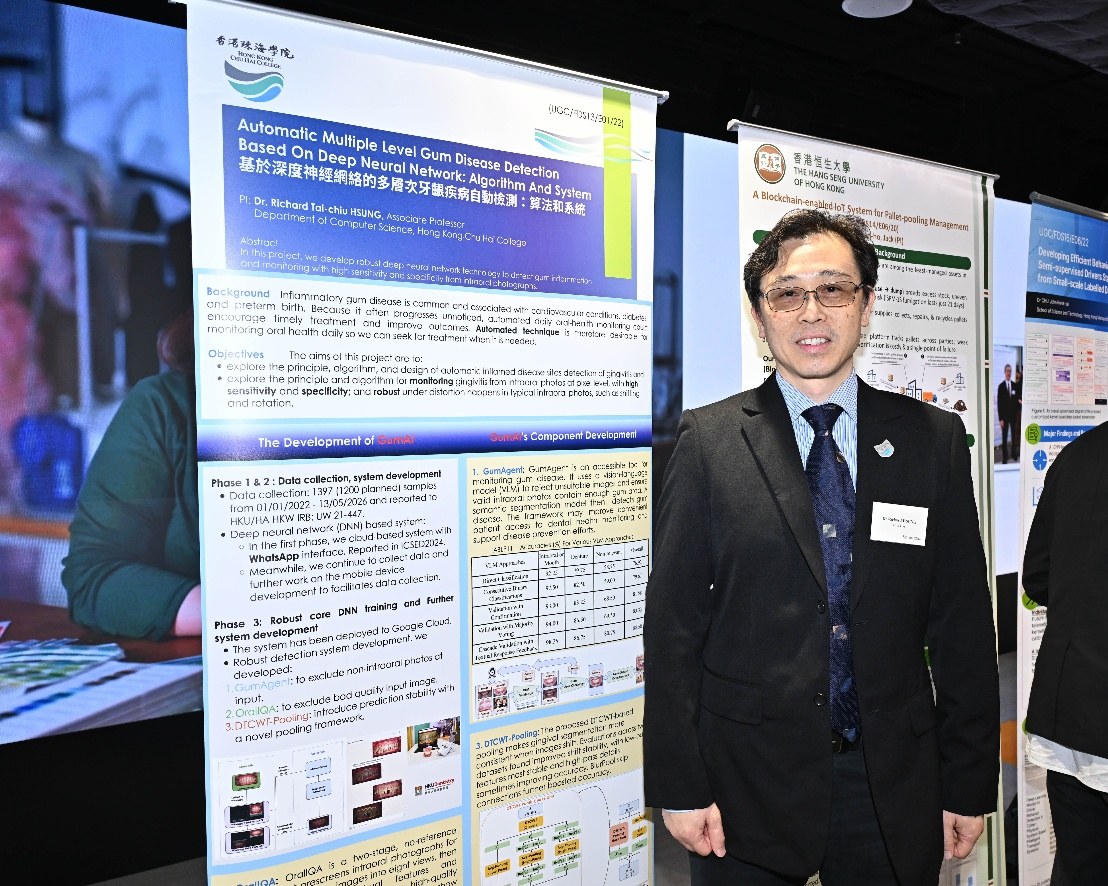
Some photos of the authors and papers