
The department of Computer Science at Hong Kong Chu Hai College is pleased to announce that a research paper co-authored by a student, Wen-Long Dong, from the 2024-25 cohort of the Master of Science in Applied Artificial Intelligence (MSAAI) programme has been officially published in Big Data and Cognitive Computing (ISSN 2504-2289), an international, peer-reviewed, Q1 open access journal published by MDPI.
The paper, titled “A Novel Multimodal Hierarchical Large Language Model for Enhancing Image and Text Sequence Recommendations in Item and User Modeling,” was published on July 29, 2026 (Volume 10, Issue 8, Article 250). The work represents a significant research contribution to the field of AI-driven e-commerce recommendation systems.
Overcoming Rigorous Review Through Diligent Revision
The publication process demanded exceptional dedication from the student researchers. Following the initial submission, the team undertook an extensive revision process that included supplementary experiments and in-depth data analysis to address reviewers’ feedback. This rigorous follow-up work—spanning multiple rounds of review and refinement—exemplifies the scholarly perseverance and research maturity cultivated within the MSAAI programme. The successful publication underscores not only the technical merit of the research but also the students’ ability to navigate the demanding peer-review standards of a high-impact international journal.
Research Breakthrough in Multimodal Recommendation Systems
Existing e-commerce recommender systems typically rely on either textual or visual features alone for item recommendations, while traditional hierarchical large language models suffer from high computational overhead for long user sequences and insufficient cross-modal semantic alignment. The proposed Multimodal Hierarchical Large Language Model (MHLLM) addresses these limitations through an innovative two-stage V-shaped architecture that decouples multimodal feature modeling from user behavior modeling.
Key innovations of the research include:
- A dual-stage framework leveraging Item-LLM for text semantics and Item-CLIP for cross-modal visual-text feature extraction
- A learnable dynamic gating mechanism for adaptive fusion of dual-modal features
- A multi-phase training strategy with lightweight feature projection to address gradient vanishing and reduce computational costs
Experimental results demonstrate that MHLLM significantly outperforms traditional systems, improving key metrics such as Recall@5 and NDCG@5 by over 20% in most cases. Additionally, the model reduces repeated inference overhead of User-LLM by more than 30% through feature caching, balancing recommendation accuracy with deployment efficiency for large-scale e-commerce applications.
Published in a Q1-Ranked International Journal
Big Data and Cognitive Computing holds a 2025 Impact Factor of 5.3, ranking in Q1 in “Computer Science, Theory and Methods” and “Computer Science, Information Systems.” The journal is indexed in Scopus, ESCI (Web of Science), dblp, Inspec, and Ei Compendex, reflecting the high scholarly standard of the publication.
A Testament to MSAAI Programme Excellence
Launched in 2024, the MSAAI programme at Hong Kong Chu Hai College has admitted over 80 outstanding students. The programme is designed to equip students with both theoretical knowledge and practical implementation skills in artificial intelligence, covering foundational AI mathematics, programming, AI theory, and state-of-the-art machine learning. This publication marks another milestone in the programme’s growing research output, following previous student research acceptances in national journals and international conferences.
Authors’ message – To all who have supported and encouraged us:
When we received the official acceptance letter from the editorial office of Big Data and Cognitive Computing, what we felt was not just joy, but a deep sense of relief. From the initial concept of a MSAAI student’s capstone project to final publication, the journey spanned nearly a year—and the part that demanded the most effort was undoubtedly the intensive revision cycles after submission.
When the first round of reviewer comments arrived, three reviewers had raised over 40 suggestions covering methodological rigor, experimental completeness, and depth of discussion. Honestly, we felt the weight of it—but we believe that: “This is a necessary step in pursuing research excellence.” So we restructured our experimental framework, added additional comparative experiments, performed more detailed ablation studies on our dynamic gating mechanism and feature caching strategy, and even rewrote nearly one‑third of the model training code. Every late‑night debugging log and every discarded draft of our figures recorded our “dialogue” with the reviewers.
Looking back, we have come to deeply appreciate that academic publication is not a “sprint” but a “marathon” requiring patience and resilience. Each revision deepened our understanding of the problem and strengthened our confidence in our research capabilities. We are especially grateful to the support from the Hong Kong Chu Hai College for providing computational resources and an inspiring academic atmosphere, and its strong support for postgraduate research.
This paper is not merely a publication—it is a “rite of passage” for our research maturity. It taught us how to handle criticism, how to pursue excellence with precision, and how to collaborate efficiently under pressure. We hope our experience can inspire our fellow students and future researchers: good work is worth the extra effort, and all the sweat will eventually crystallise into valuable knowledge on the page.
Finally, we hope this work on multimodal hierarchical large language models can offer some insights to the recommender systems community, and we look forward to further exchanges with peers.
“We are immensely proud of our MSAAI students’ achievement,” said the Department Head Prof Wai Lun Lo from the Department of Computer Science at Hong Kong Chu Hai College. “This publication not only demonstrates the research capabilities of our students but also validates the rigorous training and mentorship provided by our faculty. The dedication shown throughout the revision process—from supplementary experiments to detailed analysis—reflects exactly the kind of scholarly excellence we aim to cultivate.”
Further information
Wen-Long Dong, Richard Tai-Chiu Hsung, Harris Sik-Ho Tsang, Tony Yulin Zhu, and Wai-Lun Lo. 2026. “A Novel Multimodal Hierarchical Large Language Model for Enhancing Image and Text Sequence Recommendations in Item and User Modeling” Big Data and Cognitive Computing 10, no. 8: 250.
DOI: https://doi.org/10.3390/bdcc10080250
Research team member
Department of Computer Science at Hong Kong Chu Hai College
Mr. Wen-Long Dong, MSAAI student (2024-25 cohort)
Prof. Wai Lun Lo, Professor, Head of Department of Computer Science
Dr. Richard Tai-Chiu Hsung, Associate Professor, Department of Computer Science
Dr. Tony Zhu Yulin, Assistant Professor, Department of Computer Science
Dr Harris Sik-Ho Tsang, Assistant Professor in the Department of Computer Science
MSc in Applied Artificial Intelligence Program – Cultivating Future AI Professionals
The Master of Science in Applied Artificial Intelligence program at Hong Kong Chu Hai College aims to impart theoretical and practical knowledge in the AI field, along with design and implementation skills, to meet the growing demand for AI professionals in a rapidly evolving technological world. A unique feature of the program is its integration of AI applications in creative industries, science, and engineering, offering two professional streams: “Science and Engineering” and “Media and Innovation Applications.”
Students are required to complete a capstone project as part of the curriculum, applying their acquired knowledge to solve real-world problems under the guidance of faculty supervisors. The program adopts an interdisciplinary teaching model, combining the expertise and resources of the Department of Computer Science and the Department of Journalism and Communication. This equips graduates with a broad skill set, preparing them for diverse career roles such as AI Software Engineers, Machine Learning Engineers, Data Analysts, AI Project Managers, and more.
Notably, publication based on the research findings derived from the capstone projects demonstrate the MSAAI programme’s strong research output and the students’ significant contributions to the AI field.
MSAAI Student Wen-Long Dong’s remarks: “Studying Applied Artificial Intelligence at Hong Kong Chu Hai College and successfully obtaining my degree has laid a solid foundation for me to further develop and deepen my work in relation to the business of Tacit International Limited, empowering my career path from multiple perspectives: professional capabilities, academic qualities, and research mindset. First, systematic advanced study strengthens my theoretical foundation in AI and helps me build a complete knowledge framework, enabling me to connect technology with real corporate contexts and propose practical, implementable intelligent solutions. Second, guidance from my instructors and engagement in research projects have honed my academic and research competencies, cultivating my habits of being rigorous, grounded, logically complete, and detail-oriented. In addition, the internationalized teaching environment enhances my cross-disciplinary collaboration and communication skills within teams, supporting my future work in technology development and product iteration.”
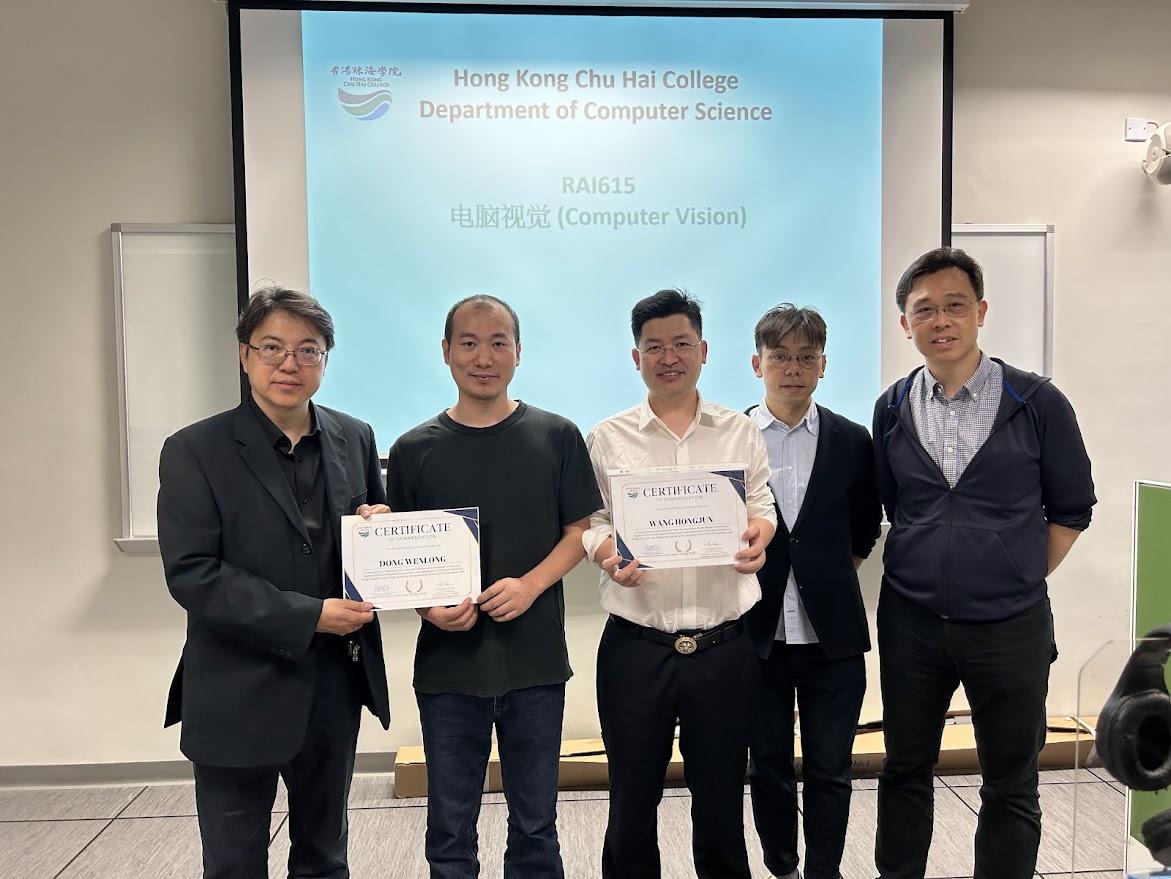
Group photo of Wen-Long Dong (second from left) with teachers.
About Hong Kong Chu Hai College
Hong Kong Chu Hai College has a long history of providing quality tertiary education. The MSc in Applied Artificial Intelligence program offers students comprehensive training in AI theory and practice, cultivating AI professionals who meet the demands of the modern era. The Department remains committed to its motto: “Grasping the Pearl of Wisdom, Vast and Broad as the Ocean.”
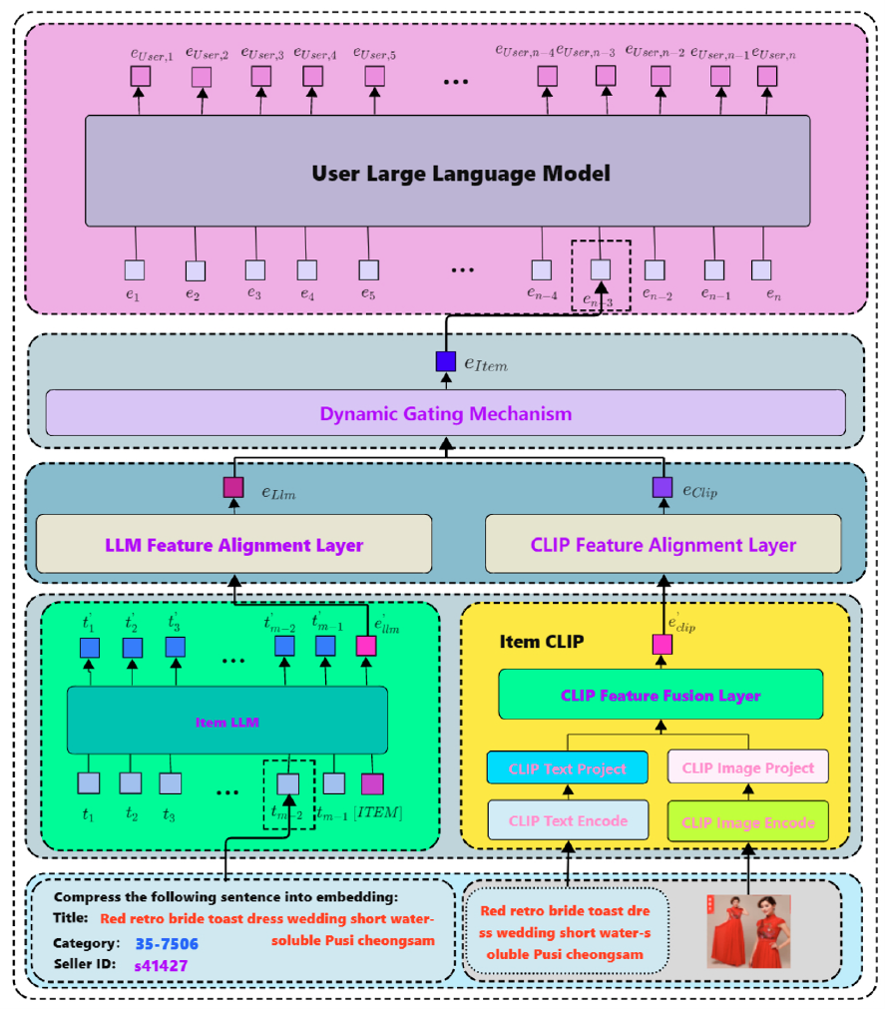
The proposed MHLLM architecture: product multimodal visual-text information and pure textual information are processed by Item-CLIP and Item-LLM, respectively, features are adaptively fused through the dynamic gating mechanism, and finally, user-aware recommendation prediction is completed by User-LLM based on the fused multimodal item features and user historical behavior sequences. (Reproduced from the publication)